

Maui Powerhouse Gym · Kihei
Know your body. Build your plan.
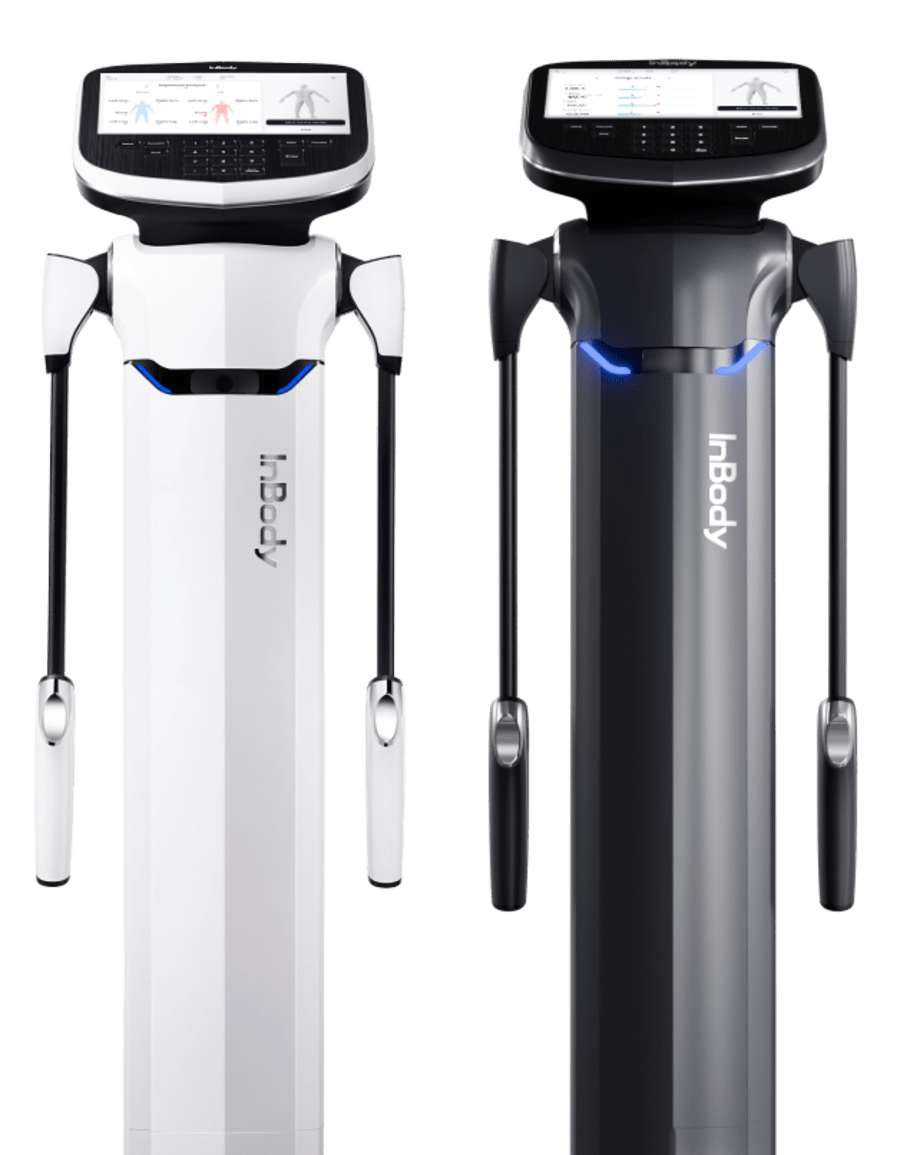
The InBody 580 gives you a medical-grade read on what your body is actually made of — muscle, fat, water, segment by segment. In about 45 seconds. Then we sit down with a coach and turn the numbers into a plan you’ll actually run.
Get started
Book your scan
What you walk away with
More than a number on a scale.
45 seconds on the platform, and you walk out with a real picture of your body — plus a coach’s read on what to do with it. Here’s what’s in your hands when you leave.
A printed result sheet you keep
The same one-page printout clinics use. Stash it in a drawer, photograph it, or build a stack next to your previous scans. It’s yours.
A baseline to measure against
Today’s numbers become the line every future scan gets compared to. Six weeks from now you’ll know if what you’re doing is actually working — or quietly isn’t.
Real numbers, not guesses
Muscle mass, body fat percentage, water balance, visceral fat — measured directly. Not estimated from your height, weight, age, or whatever the bathroom scale thought it saw.
Segmental analysis — where to focus
Five body segments measured independently. See exactly which arm is under-developed, which leg lost mass after the old injury, which side your training is favoring.
A coach-led interpretation
New members on long-term agreements can get a coach-led walkthrough as part of their Member Development Intake. We sit down right after the scan and go through the sheet line by line, so you leave understanding what each number means and which ones to move first.
A path forward for the next 90 days
A real next step — which classes match your goals, when to retest, what to eat around training, what life event we’re building toward. The numbers turn into a plan you’ll actually run.
What you’ll learn
Numbers that actually mean something
Six numbers your bathroom scale can’t give you — and what each one tells your coach about how to program your next twelve weeks.
Skeletal Muscle Mass
How much engine you’re actually carrying — the part you train.
Why it matters: muscle is your metabolic engine. More of it = better insulin sensitivity, stronger bones, and an easier time holding bodyweight steady as you age.
Body Fat Percentage
Not a scale weight — the actual ratio that drives how you look and feel.
Why it matters: two people at 180 lb can look — and function — completely differently depending on the muscle-to-fat split. The scale will never tell you which one you are.
Total Body Water
Intracellular vs. extracellular — a strong signal of recovery and hydration.
Why it matters: water inside your cells reflects healthy, well-fed muscle. Water outside the cells creeping up can flag inflammation, water retention, or a recovery debt you haven’t paid back yet.
Visceral Fat Level
The fat around your organs — the one your doctor actually worries about.
Why it matters: visceral fat wraps around your liver, heart, and gut. It’s the biggest body-comp driver of metabolic disease — and you can’t see it from the outside. The 580 puts a number on it.
Segmental Lean Analysis
Left arm vs. right arm. Legs vs. trunk. Imbalances you can train out.
Why it matters: a 10%+ left/right asymmetry is your body telling you which lift is jacking one side, which old injury never quite came back. Train accordingly.
Basal Metabolic Rate
Your baseline burn — the foundation for any honest nutrition target.
Why it matters: BMR is what your body burns just to keep the lights on. Without a real number, every calorie target you set is a guess — and most calculators online lean low.
The printout
One sheet. Everything that matters.
What’s on the sheet
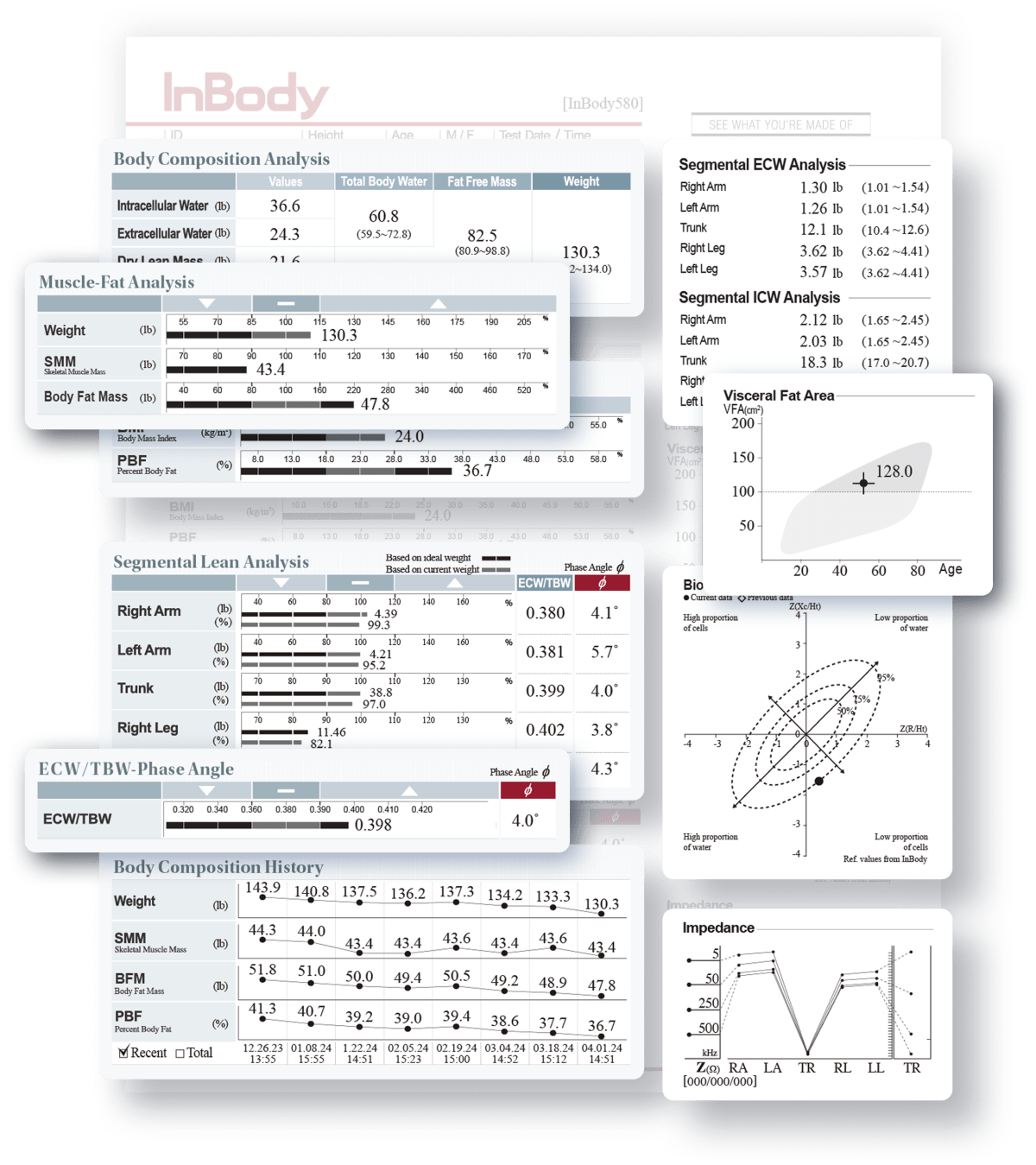
You leave with a printed result sheet, the same format clinics use. Every scan includes the full printout so you can track your numbers over time.
- Body composition breakdown — your weight split into lean mass, fat mass, and water
- Segmental lean by limb — bar charts for each arm, leg, and your trunk
- Body fat % and visceral fat level — the two numbers that actually predict health risk
- BMR + an InBody Score — a single overall snapshot you can track
- Phase angle & ECW ratio — cellular-health markers (the 580’s advanced metrics)
- A trend graph — every scan stacked, so 6 months from now you can see the line moving

The InBody App
And your results in your pocket.
Every scan syncs straight to the free InBody app on your phone. No more lost printouts, no more guessing whether you’re trending the right direction.
- Track every scan over time — see real trend lines, not vibes.
- Compare side-by-side — six months ago vs. today, segment by segment.
- Share with your coach — send results to your trainer in one tap.
- Set goals — muscle to add, fat to lose, with realistic timelines.
How accurate is it, really?
Built for the lab. Friendly enough for the gym.
The InBody 580 is a medical-grade body composition analyzer — same line of devices used in NIH research, hospital programs, and the training rooms of pro sports teams. Here’s the short version of how it works, and how it stacks up against everything else you could step on.

How it actually works
The 580 sends gentle, painless electrical currents through your body at four different frequencies. The currents move differently through muscle, fat, and water — and the device measures how much each tissue resists the flow. That’s bioelectrical impedance analysis (BIA), the same physics used in hospital body composition research.
What makes it different: instead of treating your body as one big cylinder and guessing the rest from your age and gender, it measures each arm, your trunk, and each leg separately — five independent readings, no demographic averaging.
- 4 frequencies (5, 50, 250, 500 kHz) × 5 segments = 20 direct impedance readings
- 8-point tactile electrode system — thumbs, palms, balls of feet, heels
- No demographic estimations — your numbers come from your body, not a population average
- ~45 seconds, fully clothed, no needles, no radiation
Validated against the gold standard
InBody’s body composition numbers correlate tightly with DEXA — the dual-energy X-ray scan considered the medical gold standard for body composition. Same shape of data, no radiation, no $200 copay, no waiting on a referral.
That’s why you’ll find InBody devices in NIH research, hospital obesity programs, NCAA strength labs, and the training rooms of the NFL, NHL, and Olympic committees. The same line of devices that’s sitting on our floor.
-
4Frequencies measured
-
5Segments analyzed
-
8K+Clinical studies
-
~45sPer scan
New Members · Long-Term Agreements
The Member Development Intake
When you sign up on a long-term agreement, you can inquire about an InBody scan as part of your Member Development Intake. It’s our complimentary wellness consult for committed members. You’ll get the scan, plus 30 to 45 minutes with a coach to walk through the result sheet and build a real next step around your numbers.
We use your scan to design the rest: which classes fit your goals, what your seasonal training arc should look like, when to scan again, and the life-event dates we’re training toward. Weddings, milestone birthdays, sober anniversaries, whatever matters to you.
Not on a long-term agreement? No problem. InBody scans are available to anyone. See pricing below.
-
1Get to know you
-
2InBody baseline
-
3Class + training plan
-
4Ongoing advisorship
Pricing
Scan pricing
Walk in, scan, walk out with real numbers. Pick a single or save with the 4-pack. New members on long-term agreements can inquire about a scan as part of their Member Development Intake.
Single
$50
per scan
Single scan
~45-second scan + printed result sheet. Walk-in friendly, 5 to 10 minutes total.
Best Value
$150
4-pack · $37.50/scan
4-pack
Four scans, prepaid. No expiration. Track changes over a quarter or a cut at your own pace.
New Members
MDI
long-term agreements
Member Development Intake
New members on long-term agreements can inquire about an InBody scan as part of their complimentary wellness consult with a coach.
How to book
Three ways to get scanned
New member on a long-term agreement? Ask about including an InBody scan in your Member Development Intake. You’ll get the scan plus a coach session to interpret your results and build a plan.
Everyone else: Walk in or book below. $50 single scan or $150 4-pack ($37.50/scan, no expiration).
Walk in
Open 24/7. Come by the front desk in Kihei and we’ll fit you in.
Book online
Drop your info below. Tell us which path you want and we’ll reach out to confirm.
Booking request
Tell us how to reach you
FAQ
Quick answers
How much does a scan cost?
$50 for a single scan, or $150 for a 4-pack ($37.50 per scan, no expiration). Walk in or book ahead.
New members who sign up on a long-term agreement can inquire about including an InBody scan as part of their Member Development Intake, our complimentary wellness consult with a coach.
What if I’m not a member yet?
InBody scans are available to anyone. You don’t need a membership to book a scan. Walk in, pay for a single or 4-pack, and you’ll get your full result sheet on the spot.
What’s the Member Development Intake?
The MDI is our complimentary wellness consult for new members on long-term agreements. It includes an InBody scan plus 30 to 45 minutes with a coach to walk through your results and build a training plan. If you’re signing up on a long-term agreement, ask the front desk about including an InBody scan in your intake.
Does it hurt? Is it safe?
Not at all. The InBody passes a low-level electrical current through your body to measure resistance — you won’t feel it. It’s the same BIA technology used in medical and research settings. (Note: pacemakers or other electronic implants — skip the scan and check with your doctor first.)
How is this different from the scale at home?
Home scales (even the body-fat ones) send a single low-frequency current between your feet and estimate everything else from your age and gender. The 580 sends four different frequencies through eight contact points and measures each arm, your trunk, and each leg separately. Same general technology — vastly more resolution.
Is it as accurate as a DEXA scan?
InBody’s body fat and lean mass numbers correlate tightly with DEXA in published research. DEXA is technically the medical gold standard, but it involves low-dose radiation, takes ~20 minutes, costs hundreds per session, and usually needs a referral. The 580 gives you the same shape of data, in 45 seconds, without any of that overhead — which is why it’s the standard for monthly tracking.
What should I wear? Any prep?
Regular workout clothes are fine. Step on the platform barefoot. Avoid heavy jewelry or anything metal during the scan. For the cleanest comparison scan-to-scan, try to scan at roughly the same time of day with similar food and water intake.
Last thing
Stop guessing. Get the numbers.
45 seconds on the platform, and you’ll know more about your body than the bathroom scale has told you in years. $50 single or $150 for a 4-pack. Walk in or book below.